Elevate Your Creative Workflow with Six Floral Clip Arts for Print on Demand Excellence
When building a print on demand catalog, the difference between a generic offering and a standout collection often comes down to the quality of your base assets. Floral motifs remain one of the most consistently requested design themes across home decor, apparel, stationery, and accessories. A well-curated set of six floral clip arts provides the foundational flexibility that creators, small business owners, and even educators need to produce professional-grade products without starting from scratch every time. The appeal lies not just in the flowers themselves, but in how these assets integrate into your existing workflow, whether you are designing a tote bag, a wall print, or a sheet of stickers.
Understanding the Asset Quality and Why It Matters
The zip file you receive contains six floral PNG clip arts at 700 DPI. This resolution is significantly higher than the standard 300 DPI used for most web graphics. For print on demand, resolution directly affects the sharpness and detail of the final product. When you enlarge a 700 DPI image to fit a large poster or a throw pillow, the edges remain crisp, and the fine details in the petals and leaves do not blur or pixelate. This becomes critical when your customers order a 24 by 36 inch art print from your shop. The high DPI ensures that the clip arts scale gracefully across different product dimensions, from a small sticker to a large canvas wrap. The PNG format preserves transparency, which means you can layer these floral elements over colored backgrounds, textures, or other design components without dealing with unsightly white boxes around the artwork.
It is worth noting that the six floral clip arts in this set are not merely random flower shapes. Each one is rendered with attention to botanical accuracy and aesthetic balance, giving you motifs that work equally well in rustic farmhouse designs, modern minimalist compositions, or vintage botanical layouts. The 700 DPI rating is not just a number; it represents the density of information captured in each pixel, allowing you to crop, rotate, and composite these elements repeatedly without losing fidelity.
Practical Applications Across Print on Demand Categories
One of the strengths of having six floral clip arts is the ability to create cohesive collections. For example, you can assign different flowers to different product lines while maintaining a consistent visual language. In apparel design, a single floral clip art can become the centerpiece of a t-shirt graphic, while grouping two or three of them together can form a repeating pattern for a scarf or a dress. The transparent background of the PNG files allows you to drop them onto mockups instantly, testing how they look on mugs, phone cases, or notebooks before you commit to production.
Home decor is another category where these assets shine. Consider a series of framed botanical prints. You can take one clip art, apply a subtle desaturated filter, and pair it with a clean sans-serif quote for a modern living room look. Take the same clip art, apply a warm sepia tone, and add a textured paper background to create a vintage study room aesthetic. The six clip arts give you enough variety to produce a full set of prints that customers will want to buy as a collection. Prints, patterns, and stickers all benefit from the same source material, which streamlines your inventory management and branding consistency.
Stickers are a particularly high-margin print on demand product. Because the clip arts are provided as high resolution PNGs, you can upload them directly to sticker printing platforms with minimal editing. The 700 DPI ensures that even small sticker sizes, such as two inch circles, retain the intricate details of the floral design. Die-cut stickers look especially professional when the artwork has clear boundaries and no background artifacts, which is exactly what you get with these files.
Workflow Integration and Software Considerations
Most designers will work with these floral clip arts in software such as Adobe Photoshop, Illustrator, Affinity Designer, Procreate, or Canva. The PNG format is universally compatible, so you do not need to worry about proprietary file types. If you prefer a vector workflow, you can open the SVG file included in the zip and convert the clip arts to paths, giving you infinite scalability. This is particularly useful if you want to recolor the flowers, adjust their proportions, or combine them with other vector elements. The SVG acts as a bridge between the raster detail of the PNG and the flexibility of vector editing.
For those using print on demand platforms like Printful, Printify, or Redbubble, the workflow is straightforward. Upload the PNG directly to the product designer tool, adjust the placement and size, and save your design. Because the clip arts are already at 700 DPI, you will not need to upscale them, which avoids the softness that often comes from enlarging lower resolution files. If you are creating patterns, you can import the clip art into a pattern-making tool within your design software, tile it, and export the result as a seamless repeat. The organic shapes of floral elements naturally lend themselves to pattern design because they hide seams better than rigid geometric shapes.
One consideration is file size. High DPI PNGs can be large, which may slow down some online design tools. If you experience lag, you can create a lower resolution copy specifically for the editing phase, then swap in the full resolution file before exporting the final design. This is a common practice among professionals who work with high asset quality but need speed during the layout stage.
Design Possibilities Beyond Basic Placement
The six floral clip arts are not limited to being used as standalone images. You can mask them with text to create typographic posters where the flowers fill the letters. You can use them as borders or corner accents on invitations and greeting cards. You can layer them with varying opacity to create depth in a pattern, or you can isolate specific petals or leaves to build entirely new composite floral shapes. Because you have six distinct motifs, you can mix and match elements to create a signature style that feels original even though you are working from a curated set.
For creators who sell on multiple marketplaces, having a consistent set of assets allows you to maintain brand recognition. If a customer buys a floral mug from your Etsy shop and later sees a floral phone case from your Amazon store, the visual connection reinforces your brand identity. The six clip arts provide enough variety to avoid monotony while keeping your product line visually cohesive. This is especially important for sellers who are building a recognizable style in a crowded market.
Who Benefits Most from This Asset Set
Professionals running a print on demand business will appreciate the time saved by not having to create floral elements from scratch. Instead of spending hours illustrating a single flower, you can focus on composition, typography, and product selection. Hobbyists who enjoy crafting will find these clip arts useful for scrapbooking, card making, and home decor projects where they want a polished look without advanced drawing skills. Educators teaching design or entrepreneurship can use the set as a teaching tool, showing students how to take a base asset and transform it across different product categories.
Business owners who manage multiple product lines benefit from the scalability. Whether you are creating a line of wedding invitations, a collection of botanical wall art, or a series of floral patterned journals, the six clip arts serve as your core visual vocabulary. Researchers and content creators who need botanical imagery for presentations, blog posts, or educational materials can also use these assets, provided they respect the licensing terms of the set. The high resolution ensures that even when projected on a large screen, the images retain their clarity.
Technical Specifications in Practical Terms
The 700 DPI figure warrants a closer look. Most commercial printing presses operate at 300 DPI, so these clip arts provide more than double the necessary pixel density. This overage gives you headroom for scaling up. If you take a 700 DPI image and print it at 300 DPI, you can enlarge it by roughly 233 percent before you reach the limits of the press. That means a flower that is four inches wide at native size can be printed at over nine inches wide with no loss of quality. For large format products like throw blankets or duvet covers, this flexibility is invaluable.
The PNG transparency also means you can place these clip arts on colored backgrounds without needing to manually remove white areas. This saves time and eliminates the risk of halos or rough edges around the artwork. The SVG file included in the zip gives you an alternative path for those who prefer to edit vectors. You can open the SVG in any vector editing software, ungroup the elements, and adjust individual petals or leaves. This dual format approach is rare in clip art sets and adds significant value for designers who work across both raster and vector workflows.
When you receive the zipped file, it is good practice to extract the contents to a dedicated folder on your local drive or cloud storage. Organizing the six PNGs and the SVG file with clear naming conventions will save you time when you are searching for a specific floral motif later. Some creators also create a master file that contains all six clip arts arranged on a single canvas, allowing them to preview the entire set at a glance. This master file can serve as a reference sheet when you are planning a new product line.
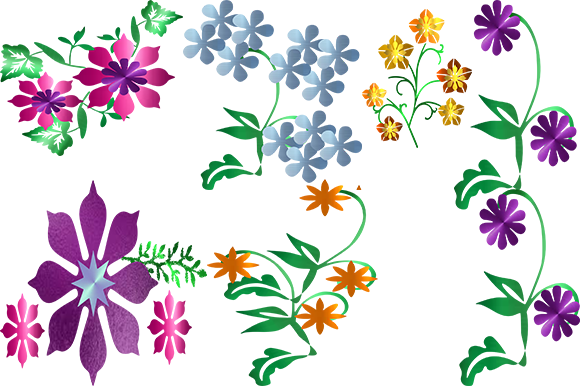
The six floral clip arts are designed to complement each other without overlapping in style or complexity. You will find both large statement blooms and smaller accent flowers, which gives you natural hierarchy when composing layouts. The variety ensures that you can create balanced designs without needing to source additional elements. For print on demand sellers, this reduces the number of assets you need to manage and simplifies the design approval process. Instead of juggling dozens of individual files, you can focus on a tight, versatile set that covers a wide range of applications.
In practice, the most successful print on demand products using floral clip arts tend to be those where the flower is not just decoration but an integral part of the composition. Whether you are building a pattern, a standalone print, or a sticker sheet, treating each clip art as a design element with its own personality will yield the strongest results. Experiment with scale, rotation, and color overlays to find combinations that resonate with your target audience. The high resolution and dual format support give you the technical freedom to explore without constraints, and the curated nature of the set means you are starting with professionally crafted source material every time.