Apple Jam in Line Art Trend: Exploring Vector Patterns, Swatches, and Digital Design Elements
The fusion of culinary motifs with minimalist line art has created a distinctive visual language in contemporary design. Among the more unexpected yet delightful subjects to receive this treatment is apple jam, a classic preserve that now appears reimagined through clean strokes, open spaces, and structured compositions. The Apple Jam in Line Art Trend represents a specific design resource that bundles pattern swatches, vector elements, and high-resolution seamless patterns into a single cohesive toolkit. Understanding what this collection offers, how it functions across different creative workflows, and where it fits within broader design trends can help professionals and hobbyists alike make informed decisions about integrating such assets into their projects.
What the Apple Jam Line Art Collection Actually Contains
This particular resource is packaged as a zip archive with multiple file types, each serving a distinct purpose in the design pipeline. The EPS-CS file includes six pattern swatches that can be loaded directly into the Swatches Palette within Adobe Illustrator. These swatches are not merely static images but fully editable vector patterns, meaning users can scale, rotate, recolor, and combine them without losing any resolution. For designers who work extensively with pattern fills, having these swatches readily available in the palette saves considerable time compared to manually constructing repeating motifs from scratch.
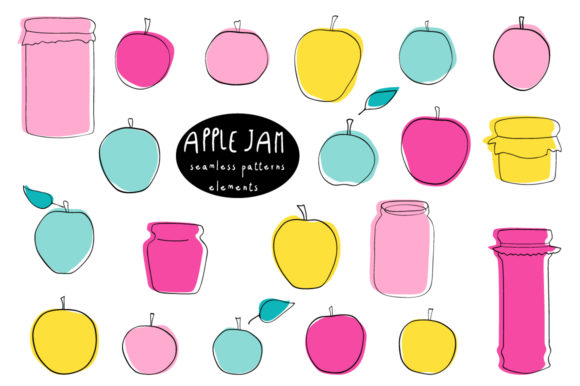
The collection also includes six high-resolution JPG seamless patterns at 4861x4861 pixels. These raster versions are immediately usable in applications that do not support vector files, such as raster-based image editors, print-on-demand platforms, or presentation software. The resolution is substantial enough for large-format printing, poster designs, or fabric mockups where fine detail matters. Additionally, four high-resolution PNG files at 11278x7506 pixels contain sets of individual design elements presented in both color and line-art variations. These elements might include jars, fruit slices, dripping jam, splatters, leaves, and decorative accents that can be composed into original layouts.
The distinction between the vector swatches and the raster element sets is important to grasp. The swatches are repeating patterns meant for fills and backgrounds, while the PNG elements are standalone illustrations that can be placed, layered, and scaled within a composition. Together, they form a comprehensive toolkit rather than a single-use asset.
Understanding the File Formats and Their Practical Implications
For creative professionals, file format compatibility directly affects workflow efficiency. The EPS-CS format, which stands for Encapsulated PostScript with Creative Suite compatibility, is widely supported across vector editing software including Adobe Illustrator, CorelDRAW, and Affinity Designer. The inclusion of six pattern swatches in this format means that a graphic designer working on branding materials can open the file, drag the swatches into their palette, and immediately apply them to shapes, text, or background layers. The patterns remain fully editable, allowing adjustments to color harmony, scale, and rotation to suit a specific project palette.
The high-resolution JPG seamless patterns serve a different but equally valuable purpose. Because they are rasterized, they can be used in environments where vector support is unavailable. A social media manager creating Instagram templates, a web designer building a hero section background, or a crafter printing gift wrap can all utilize these files without needing specialized software. The 4861x4861 pixel dimension ensures that even when the pattern is scaled up for a banner or a textile print, the detail remains sharp and the repetition remains invisible across seams.
The PNG element sets, at the notably large resolution of 11278x7506 pixels, offer the highest level of detail. These files include both color versions and line-art versions of each element. The line-art variants are particularly valuable for designers who wish to recolor the elements themselves or integrate them into projects that require a monochromatic, hand-drawn aesthetic. The color versions provide a ready-to-use option for projects that need immediate visual impact without additional editing.
The Aesthetic Appeal of Apple Jam as a Line Art Subject
Line art, as a stylistic approach, relies on the purity of contour and the absence of shading gradients or complex textures. When applied to a subject like apple jam, the result is both nostalgic and modern. Apple jam itself carries connotations of homemade preserves, autumn harvests, and comfort food traditions. Translating that into line art strips away the photographic realism and distills the subject down to its essential shapes: the curve of a glass jar, the irregular drip of syrupy jam, the silhouette of an apple or a slice.
The line art trend has grown steadily across branding, packaging, editorial illustration, and digital design because it offers clarity and versatility. A line art illustration of apple jam can appear equally at home on a rustic farm-to-table restaurant menu, a minimalist skincare product label, or a whimsical children's cookbook. The Apple Jam in Line Art Trend resource capitalizes on this versatility by providing multiple variations of the same thematic elements, allowing designers to maintain visual consistency while adapting the artwork to different contexts.
Furthermore, the combination of pattern swatches and individual elements means that a designer is not limited to using only full-page patterns or only isolated icons. They can, for example, use a seamless apple jam pattern as a wrapping paper design and then overlay a line art jar element as a focal point, creating a layered composition that feels intentional and rich.
Who Benefits Most from This Type of Design Resource
Packaging designers working in the food and beverage industry will find immediate utility in the pattern swatches. A line art pattern featuring apple motifs and jam drips can serve as a subtle background for a jar label, a box insert, or a shopping bag design. The ability to recolor the vector patterns to match a brand's existing palette ensures that the design feels cohesive rather than generic.
Surface pattern designers and textile artists often build entire collections around a single theme. The element sets provide a starting point for creating custom repeats, placement prints, or embroidered patches. The high-resolution PNGs allow for direct use in print-on-demand platforms such as Spoonflower or Printful, where vector file support may be limited.
Stationery designers and invitation creators can incorporate both the patterns and the elements into wedding suites, party invitations, or greeting cards. The apple jam theme, while specific, evokes warmth and domesticity, making it suitable for autumn celebrations, harvest festivals, or cozy gatherings. The line art style keeps the overall look refined and prevents the design from feeling overly thematic or juvenile.
Educators and content creators can use the elements for instructional materials, recipe cards, or digital worksheets. The clarity of line art reproduces well in black-and-white printing, which is often a practical consideration for educational handouts. The color variants can be used in digital presentations or blog graphics where visual appeal is paramount.
How to Integrate Swatches and Elements into a Real Workflow
A practical workflow might begin with opening the EPS-CS file in Adobe Illustrator and loading the six pattern swatches into the Swatches Palette. A designer creating a mockup for a jam jar label could draw a rectangular shape representing the label area and fill it with one of the patterns. Because the pattern is vector, scaling it to fit the label size is as simple as adjusting the transform properties. The designer can then place individual line art elements from the PNG sets onto the label, arranging them around the brand name or product description.
For a web designer, the high-resolution JPG patterns can be used as background textures for a landing page about artisanal food products. The seamless nature of the patterns ensures that they tile perfectly across screens of different sizes. The PNG elements might serve as decorative dividers, bullet points, or hover-state icons. Because the PNGs include both color and line-art versions, the designer can use the line-art version for a minimal look and switch to the color version for emphasis on particular sections.
A surface pattern designer creating a fabric collection could import the vector swatches into a pattern design program and build additional repeats around them. The six swatches serve as a foundation, but the individual elements can be arranged into entirely new repeat patterns that feel original while still belonging to the same visual family. This approach saves time while ensuring thematic consistency across a product line.
Characteristics That Set This Resource Apart from Generic Pattern Collections
Many pattern collections offer only raster files or only vector swatches, but rarely both in a coordinated package. The inclusion of six pattern swatches in the Swatches Palette format ensures that Adobe Illustrator users can access them with minimal friction. The separate high-resolution JPG and PNG files extend the usability to designers who may not own vector software or who need ready-to-place raster assets for rapid prototyping.
The thematic specificity of apple jam also distinguishes this collection from generic food or fruit pattern sets. Rather than offering ambiguous fruit silhouettes that could apply to any project, the elements are clearly informed by the visual language of preserves: jars with cloth covers, sticky drips, fruit slices, and spoonfuls of glossy jam. This specificity makes the collection ideal for brands and creators who want their visuals to communicate a particular narrative around artisanal production, homemade quality, or seasonal ingredients.
The resolution of the raster files deserves particular attention. At 4861x4861 pixels for the seamless patterns and 11278x7506 pixels for the element sets, the assets are suitable for both digital and print applications. A pattern at this resolution can be printed at 300 DPI on a surface approximately 16 inches square, which covers most packaging, stationery, and textile use cases. The element sets, at even higher resolution, allow for large-scale printing or cropping without losing sharpness.
Considerations When Working with Pre-Made Pattern Swatches and Elements
While the convenience of ready-made swatches and elements is considerable, designers should be aware of a few practical considerations. Vector swatches from an external source may use colors that do not match an existing brand palette, but the editable nature of the EPS-CS file means that recoloring is straightforward in Illustrator. Users should check whether the swatches are defined as global swatches, which allow for one-click color updates across all instances, or as local swatches that require individual adjustments.
Similarly, the seamless patterns in JPG format may require color adjustment to harmonize with other design elements. Because they are raster files, recoloring is less flexible than with vectors, but adjustments to hue, saturation, and contrast can be made in any image editing software. The high resolution of the JPGs ensures that such adjustments do not introduce visible artifacts or banding.
The PNG element sets, while large and detailed, are flattened raster images. Designers who need to isolate specific parts of an element or modify individual strokes may find the line-art versions more suitable for tracing or vectorization. The line-art PNGs can be imported into Illustrator and converted to vectors using image trace, though this process may require cleanup depending on the complexity of the original lines.
The Broader Context of Line Art Trends in Contemporary Design
The line art trend has persisted across multiple design cycles because it offers a solution to several competing demands. Consumers increasingly favor clean, uncluttered visuals that communicate quickly and feel authentic rather than overly produced. Line art achieves this by presenting subjects in their simplest recognizable form. The Apple Jam in Line Art Trend resource aligns with this broader movement by offering a subject that is inherently relatable and treating it with a style that feels both handcrafted and modern.
For business owners and content creators who are not professional designers, line art resources lower the barrier to creating polished visuals. A seamless pattern and a set of coordinated elements can transform a plain background or a basic document into something that looks intentionally designed. The combination of pattern swatches and individual elements within this collection means that even someone with minimal design experience can produce cohesive results by simply filling shapes with patterns and placing elements as accents.
The resurgence of interest in craft and homemade aesthetics, particularly in food and lifestyle branding, further supports the relevance of this resource. Apple jam as a subject speaks to traditions of preservation, seasonal cooking, and small-batch production. Presenting it in line art rather than photography allows brands to evoke those associations without committing to a specific photographic style that might date quickly.
Researchers and educators studying contemporary visual culture may find the collection useful as an example of how niche subjects are packaged into design assets. The bundling of vector swatches, raster patterns, and element sets reflects an industry trend toward comprehensive toolkits that anticipate multiple use cases, rather than single-format downloads that require the user to adapt them.
Practical Examples of Usage Across Different Projects
Consider a small business that produces artisanal apple jam and sells it at farmers markets. The owner wants to create labels, a website banner, social media graphics, and a recipe card to include with each jar. Using the vector swatches from the EPS-CS file, a label can be designed with a subtle repeating pattern behind the product name. The line-art jar elements can be placed on the label as a central illustration. For the website banner, the high-resolution JPG seamless pattern can serve as a background texture, with the color PNG elements arranged as decorative accents around the headline.
A graphic design educator might use the collection as a teaching tool for a unit on pattern design and file formats. Students can examine how the same theme is represented in vector swatches versus raster patterns, and how the resolution and file format affect the final output. The exercise of recoloring the vector swatches or tracing the line-art elements can reinforce practical skills in software like Illustrator and Photoshop.
A stationery designer preparing a custom wedding suite for an autumn-themed event could incorporate the apple jam line art elements as decorative motifs on invitations, place cards, and menus. The line art style keeps the designs elegant and cohesive, while the pattern swatches can be used for envelope liners or backing paper. Because the assets are coordinated, the entire suite maintains a consistent visual identity without requiring the designer to draw every element from scratch.
The availability of both color and line-art PNGs also supports accessibility needs. Line art elements can be used in high-contrast designs that are easier to read for individuals with visual impairments, while color elements provide additional visual interest for viewers who can perceive color. Designers creating materials for diverse audiences can choose the variant that best suits each context.
Final Observations on Working with This Type of Resource
The value of a well-structured design resource lies not only in the quality of the individual assets but in how easily they can be combined and adapted. The Apple Jam in Line Art Trend collection achieves this by offering multiple file formats, both vector and raster, along with a clear thematic focus. Whether the goal is to create a cohesive brand identity for a food product, design stationery for a seasonal event, or develop educational materials with a warm visual tone, the swatches and elements provide a foundation that can be customized to fit specific requirements.
Understanding the appropriate use cases for each file type helps maximize the return on investment in such resources. Vector swatches are best for ongoing projects where flexibility in scaling and recoloring is important. Raster patterns are ideal for quick application in environments where vector software is not available. Individual elements, particularly in line art form, offer the greatest versatility for original composition. By recognizing the strengths of each format, designers and creators can build workflows that are efficient, consistent, and visually compelling.